On 22 October, the Office for National Statistics published the latest figures from the Annual Survey of Hours and Earnings (ASHE). These include the revised figures for 2025 and the provisional figures for 2026. The key index for those administering Periodical Payment Orders (PPOs) is ASHE 6115, which is an index based on an amalgamation of care earnings data from two Standard Occupational Classifications (SOC).
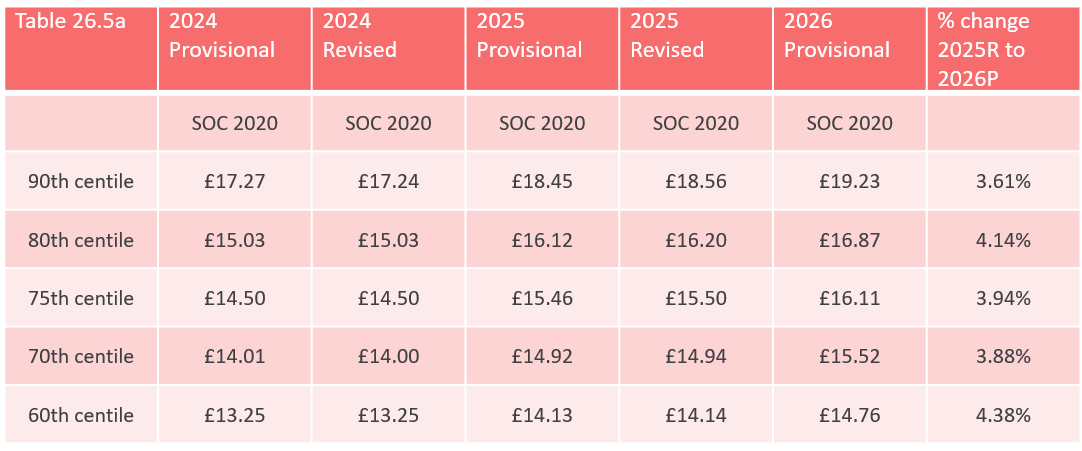
The latest ASHE figures show continued upward movement in care-sector earnings, although growth has slowed from the levels recorded last year. The 80th centile increased by 4.14%, from £16.20 in the 2025 revised data to £16.87 in the 2026 provisional data, while the average increase across the 60th to 90th centiles was 3.99% compared to 6.82% in the previous release.
Increases were recorded across every centile, ranging from 3.61% to 4.38%. This points to sustained, broad-based wage growth across care roles and will feed through to a corresponding increase in ASHE-linked periodical payments recalculated against the new figures.
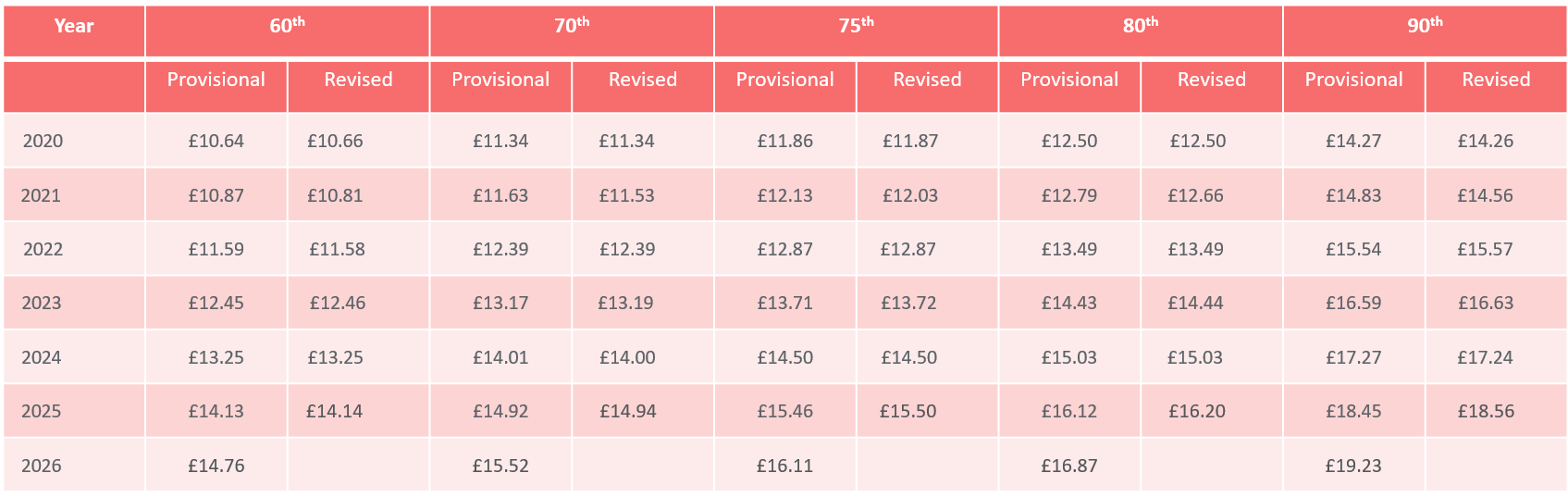
Click here for the full table 26.5a.
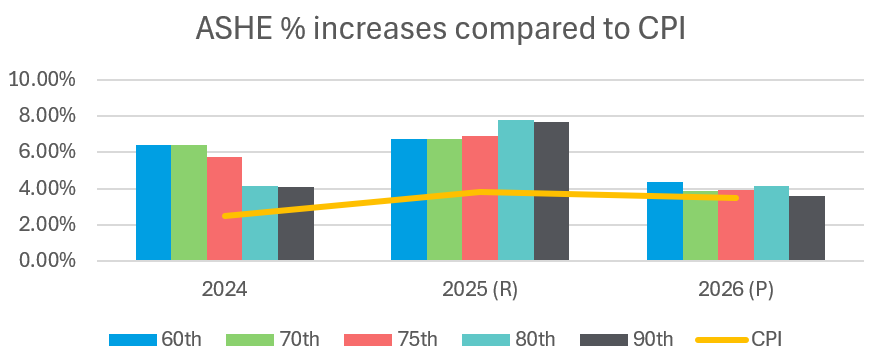
The extent of these increases (3.99%) is not unexpected and they are broadly comparable with our own analysis of agency care rates based on the first six months of 2026 which reported that the rates of agency care inflation were beginning to slow down. This analysis will be reviewed in January 2027. The increases are broadly comparable with other indices i.e. the current RPI and CPI figures, and the rise in the National Living Wage.
As is widely reported, there remains a shortage of workers in the care sector. These increases in hourly rate will of course mean a corresponding increase in the value of periodical payments that fall to be paid this year. Those regularly dealing with cases involving large packages of care and fully versed in the ongoing challenges of recruiting suitable carers will not be surprised by this, although as ever the increasing costs of agency care when compared to what carers are actually paid is worth scrutiny. Increases in hourly rates at this level will continue to be referred to by claimant’s legal teams when arguing that a PPO represents the best way of awarding damages for future care. Of course, the arguments for and against a PPO as a form of award are more nuanced than that and remain very case specific.
The current CPI and RPI rates are 3.5% and 3.9% respectively.
The National Living Wage figure (for those aged 21 and over) rose to £12.71 from April 2026 which was an increase of 4.1%. That increase will not be reflected in the ASHE 2026 release as the data collection period ended in April this year but will be reflected in the 2027 release.
The graph below compares the ASHE increases for inflation.
The ONS approach to care data recognises that a care package may involve different types of carers and rates. Simply taking an average of all those to produce one ASHE rate would produce a distorted figure based on the same hours all producing the same rate. Instead, ASHE 6115 is based on a weighted calculation which takes into account the different hours at each hourly rate.
In the normal course, the ASHE figures are produced on a provisional basis for the following year at the same time as revised figures are published for the previous year (i.e. a revision of the previous year’s provisional figures). Typically, any difference between the provisional figure one year and the revised figure published the following year is minimal. It can be seen from the table above that the adjustments between the 2025 provisional and revised figures are minimal, with slightly greater increases across the 80th and 90th centiles.
Most periodical payment sums are recalculated around this time of year, based on the latest ASHE 6115 data and ahead of a typical payment due date in mid-December. That recalculation effectively uplifts the original payment sum due under the periodical payment order by the ratio of the new index compared with the old index (meaning the sum owed can go up or down).
If you would like our assistance in relation to PPOs or a discussion more generally around care costs, please do not hesitate to contact us.

Designed to elevate the policyholder experience and empower handlers, ClaimPilot transforms the claims journey with state-of-the-art AI, streamlined processes and reduced operational bottlenecks – all in one powerful platform.